


Hey there! As a supplier of Carboxymethyl Beta - Cyclodextrin, I've got a lot to share about how it interacts with cyclodextrin - based polymers. Cyclodextrins are pretty cool molecules, and understanding their interactions can open up a whole new world of applications.
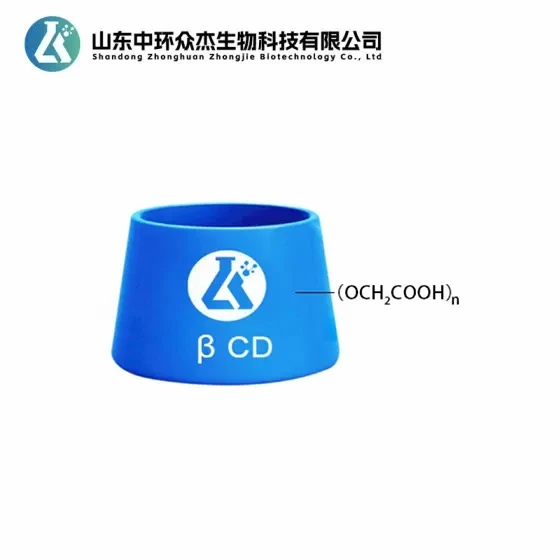
First off, let's talk a bit about what Carboxymethyl Beta - Cyclodextrin is. It's a modified version of beta - cyclodextrin. Beta - cyclodextrin is a cyclic oligosaccharide made up of seven glucose units, and it has this unique cone - shaped structure with a hydrophobic cavity inside and a hydrophilic exterior. When we carboxymethylate it, we're adding carboxymethyl groups to the hydroxyl groups on the cyclodextrin. This modification changes its properties, making it more soluble in water and giving it some new functions.
Now, cyclodextrin - based polymers are polymers that have cyclodextrin units in their structure. These polymers can be synthesized in different ways, and they can have various properties depending on how they're made. Some common types of cyclodextrin - based polymers include cross - linked polymers and graft polymers.
One of the main ways Carboxymethyl Beta - Cyclodextrin interacts with cyclodextrin - based polymers is through inclusion complex formation. The hydrophobic cavity of Carboxymethyl Beta - Cyclodextrin can host hydrophobic guest molecules. In the case of cyclodextrin - based polymers, parts of the polymer chain that are hydrophobic can fit into the cavity of Carboxymethyl Beta - Cyclodextrin. This forms an inclusion complex, which can change the properties of both the Carboxymethyl Beta - Cyclodextrin and the polymer.
For example, the solubility of the polymer can be improved. If a cyclodextrin - based polymer has some hydrophobic segments that make it less soluble in water, the inclusion complex with Carboxymethyl Beta - Cyclodextrin can help it dissolve better. This is because the hydrophilic exterior of Carboxymethyl Beta - Cyclodextrin can interact with water molecules, while the hydrophobic part of the polymer is safely tucked inside the cavity.
Another interesting interaction is through electrostatic interactions. The carboxymethyl groups on Carboxymethyl Beta - Cyclodextrin are negatively charged at physiological pH. If the cyclodextrin - based polymer has positively charged groups, there can be strong electrostatic attractions between them. These electrostatic interactions can lead to the formation of aggregates or complexes with different structures.
The formation of these complexes can have a big impact on the applications of both Carboxymethyl Beta - Cyclodextrin and cyclodextrin - based polymers. In the pharmaceutical industry, for instance, they can be used to improve the solubility and bioavailability of drugs. Many drugs are hydrophobic and have poor solubility in water, which makes it hard for them to be absorbed by the body. By forming inclusion complexes with Carboxymethyl Beta - Cyclodextrin and cyclodextrin - based polymers, the solubility of these drugs can be increased, and they can be delivered more effectively to the target tissues.
In the food industry, these interactions can also be useful. They can be used to encapsulate flavors and nutrients, protecting them from degradation and controlling their release. For example, a flavor compound can be included in the cavity of Carboxymethyl Beta - Cyclodextrin, and then the complex can interact with a cyclodextrin - based polymer to form a stable delivery system. This way, the flavor can be released slowly over time, giving a more long - lasting taste.
Let's also talk about some of the factors that affect these interactions. The degree of substitution of the carboxymethyl groups on Carboxymethyl Beta - Cyclodextrin is an important factor. A higher degree of substitution means more carboxymethyl groups, which can increase the solubility and the electrostatic interactions. The structure of the cyclodextrin - based polymer, such as the type of cross - linking and the length of the polymer chain, also plays a role.
The pH of the solution can also have a big impact. At different pH values, the charge on the carboxymethyl groups can change, which can affect the electrostatic interactions. For example, at low pH, the carboxymethyl groups may be protonated, reducing the negative charge and weakening the electrostatic attractions.
If you're interested in other cyclodextrin products, we also offer 2,6 - Dimethyl - Beta - Cyclodextrin and Hydroxypropyl - Beta - Cyclodextrin Aqueous Solution. These products also have their own unique properties and applications, and they can interact with cyclodextrin - based polymers in different ways.
As a supplier of Carboxymethyl Beta - Cyclodextrin, I'm always excited to see how our customers use our products. Whether you're in the pharmaceutical, food, or other industries, we can provide high - quality Carboxymethyl Beta - Cyclodextrin to meet your needs. If you're interested in learning more about how it can interact with cyclodextrin - based polymers or if you want to discuss a potential purchase, feel free to reach out. We're here to help you explore the amazing world of cyclodextrins and their applications.

In conclusion, the interaction between Carboxymethyl Beta - Cyclodextrin and cyclodextrin - based polymers is a fascinating area of study. It offers many opportunities for developing new materials and products with improved properties. If you have any questions or want to start a procurement discussion, don't hesitate to get in touch.
References
- Szejtli, J. (1998). Introduction and general overview of cyclodextrin chemistry. Chemical Reviews, 98(5), 1743 - 1753.
- Loftsson, T., & Duchêne, D. (2007). Cyclodextrins and their pharmaceutical applications. International Journal of Pharmaceutics, 329(1 - 2), 1 - 11.
- Harada, A., Li, J., & Kamachi, M. (2009). Cyclodextrin - based supramolecular polymers. Chemical Reviews, 109(11), 5974 - 6023.


