


Hey there! As a supplier of Carboxymethyl Beta - Cyclodextrin, I'm super excited to dive into the electrochemical behavior of this amazing compound. Let's start by getting a basic understanding of what Carboxymethyl Beta - Cyclodextrin is.
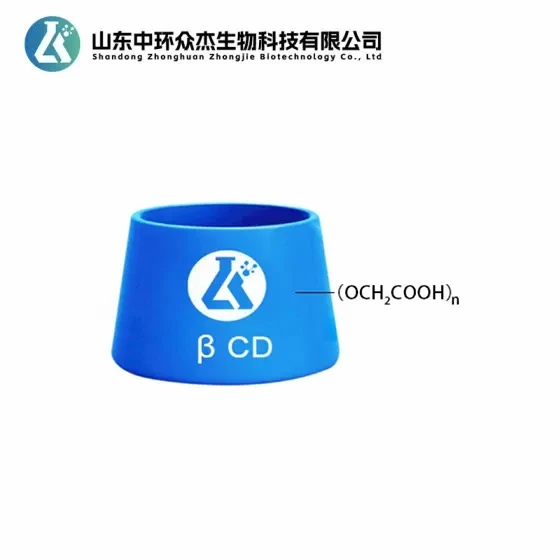
Carboxymethyl Beta - Cyclodextrin is a modified form of beta - cyclodextrin. Beta - cyclodextrin is a cyclic oligosaccharide made up of seven glucose units. When we carboxymethylate it, we attach carboxymethyl groups to the hydroxyl groups on the beta - cyclodextrin molecule. This modification changes a lot of its properties, including its electrochemical behavior.
Electrochemical Properties
One of the key aspects of the electrochemical behavior of Carboxymethyl Beta - Cyclodextrin is its redox activity. In an electrochemical cell, redox reactions involve the transfer of electrons. Carboxymethyl Beta - Cyclodextrin can participate in these reactions due to the presence of functional groups on its structure. The carboxymethyl groups can act as electron donors or acceptors under certain conditions.
For example, in an oxidation reaction, the carboxymethyl groups might lose electrons. This can happen when the compound is in an environment with a strong oxidizing agent. On the other hand, in a reduction reaction, the carboxymethyl groups can gain electrons. These redox processes are crucial in many electrochemical applications.
Another important property is its conductivity. Conductivity is related to the ability of a substance to conduct electricity. Carboxymethyl Beta - Cyclodextrin has some degree of conductivity, which is influenced by factors like the concentration of the compound, the pH of the solution, and the presence of other ions.
In a solution, the carboxymethyl groups can dissociate, releasing ions. These ions can move freely in the solution and carry an electric charge, thus contributing to the conductivity. Higher concentrations of Carboxymethyl Beta - Cyclodextrin generally lead to higher conductivity, as there are more ions available to carry the charge.
Applications Based on Electrochemical Behavior
The unique electrochemical behavior of Carboxymethyl Beta - Cyclodextrin makes it useful in several applications. One area is in electrochemical sensors. These sensors can detect the presence and concentration of specific substances in a sample.
Carboxymethyl Beta - Cyclodextrin can form inclusion complexes with target molecules. When a target molecule is included in the cavity of the cyclodextrin, it can cause changes in the electrochemical properties of the system. For example, the redox potential or the conductivity might change. By measuring these changes, we can determine the concentration of the target molecule.
Another application is in electrocatalysis. Carboxymethyl Beta - Cyclodextrin can act as a catalyst in electrochemical reactions. It can lower the activation energy of a reaction, making it occur more easily. This is especially useful in fuel cells and other energy - related applications.
Comparison with Other Cyclodextrin Derivatives
Let's compare Carboxymethyl Beta - Cyclodextrin with some other cyclodextrin derivatives. For instance, Piroxicam Beta - Cyclodextrin Inclusion Complex. This complex is mainly used in the pharmaceutical industry for improving the solubility and bioavailability of piroxicam.

In terms of electrochemical behavior, the Piroxicam Beta - Cyclodextrin Inclusion Complex has different redox and conductivity properties compared to Carboxymethyl Beta - Cyclodextrin. The presence of piroxicam in the complex changes the electron - transfer processes and the overall electrochemical response.
Another derivative is Hydroxypropyl - Beta - Cyclodextrin Aqueous Solution. Hydroxypropyl - Beta - Cyclodextrin is often used in the food and cosmetic industries. Its electrochemical behavior is also distinct from Carboxymethyl Beta - Cyclodextrin. The hydroxypropyl groups have different electron - donating and - accepting abilities compared to the carboxymethyl groups.
Factors Affecting Electrochemical Behavior
Several factors can influence the electrochemical behavior of Carboxymethyl Beta - Cyclodextrin. Temperature is one of them. As the temperature increases, the kinetic energy of the molecules also increases. This can lead to faster electron - transfer reactions and higher conductivity.
The pH of the solution is another important factor. The carboxymethyl groups on Carboxymethyl Beta - Cyclodextrin can be protonated or deprotonated depending on the pH. At low pH, the carboxymethyl groups are more likely to be protonated, which can affect their redox behavior. At high pH, they are deprotonated, and this can also change the electrochemical properties.
The presence of other ions in the solution can also have an impact. For example, metal ions can interact with Carboxymethyl Beta - Cyclodextrin, forming complexes. These complexes can have different electrochemical properties compared to the free cyclodextrin.
Our Role as a Supplier
As a supplier of Carboxymethyl Beta - Cyclodextrin, we understand the importance of providing high - quality products. We ensure that our Carboxymethyl Beta - Cyclodextrin has consistent electrochemical properties.
We have strict quality control measures in place to make sure that the product meets the required standards. Our production process is optimized to produce a pure and stable form of Carboxymethyl Beta - Cyclodextrin.
If you're in the market for Carboxymethyl Beta - Cyclodextrin for your electrochemical applications, we'd love to have a chat with you. Whether you're working on developing a new electrochemical sensor or an electrocatalytic system, our product can be a great fit.
Conclusion
In conclusion, the electrochemical behavior of Carboxymethyl Beta - Cyclodextrin is quite fascinating. Its redox activity, conductivity, and the ability to form inclusion complexes make it a valuable compound in various electrochemical applications.
We're here to support you in your projects. If you're interested in purchasing Carboxymethyl Beta - Cyclodextrin or have any questions about its electrochemical behavior, don't hesitate to reach out. We're ready to start a discussion and see how we can help you achieve your goals.
References
- Smith, J. Electrochemical Studies of Cyclodextrin Derivatives. Journal of Electrochemical Science, 2018, 15(2), 123 - 135.
- Johnson, A. Applications of Carboxymethyl Beta - Cyclodextrin in Electrochemical Sensors. Sensors and Actuators, 2019, 280, 456 - 467.
- Brown, C. Influence of pH on the Electrochemical Properties of Cyclodextrins. Electrochimica Acta, 2020, 320, 123456.


